


Journey of Recovery and Stability in Advanced Rectosigmoid Cancer with ECCT Support
- Mar 29
- 3 min read
Updated: Mar 30

When 53-year-old Juliana Asfalinda, Malaysia was first diagnosed with advanced rectosigmoid cancer in April 2025, her life changed almost overnight. What initially began as a tumour measuring 3.8 × 2.2 cm soon revealed itself to be more aggressive than expected, with invasion into surrounding tissues and spread to nearby lymph nodes (4 out of 11 positive).
She underwent surgery in May 2025 to remove the tumour. At that point, there was hope. However, due to a delay in starting chemotherapy, things quickly took a turn. Within just two months, she began experiencing persistent abdominal pain. At first, it seemed like something minor, “just gas,” she thought, but the discomfort worsened.
Further investigations in October 2025 confirmed what no patient wants to hear: the cancer had returned and spread. Scans showed active disease in the bowel, lymph nodes, and even nodules in the abdominal wall.
Before ECCT: Weak, In Pain, and Losing Weight
By the time Juliana started treatment again in October 2025, her condition had significantly declined.
She was dealing with constant abdominal pain, described as a pulling, tightening sensation, along with bloating, vomiting, and a severely reduced appetite. Eating became difficult, and she relied on liquid nutrition just to get through the day. She lost about 5 kg in a short period.
Physically, she was weak and lethargic, often needing to lie down during consultations. Even basic daily activities felt exhausting.
Starting Treatment: Combining Chemotherapy with ECCT
Determined to fight back, Juliana began chemotherapy (initially Xeloda, later Oxaliplatin-based regimens) on 6 October 2025. At the same time, she started ECCT on 10 October 2025.
The early phase was not easy. Like many patients undergoing chemotherapy, she experienced side effects, insomnia, poor appetite, cold sensitivity, and fatigue. There were also episodes of severe abdominal pain and weakness.
But gradually, something began to change.
Signs of Improvement: Tumour Markers and Scan Results
One of the clearest signs came from her tumour marker (CEA), which steadily decreased after starting treatment:
From 21 (April 2025)
Down to 10.7 in early October
Further reduced to 9.4, then 6.4
And eventually reaching 2.9 by March 2026
This consistent downward trend into near-normal levels suggested a meaningful reduction in tumour activity.
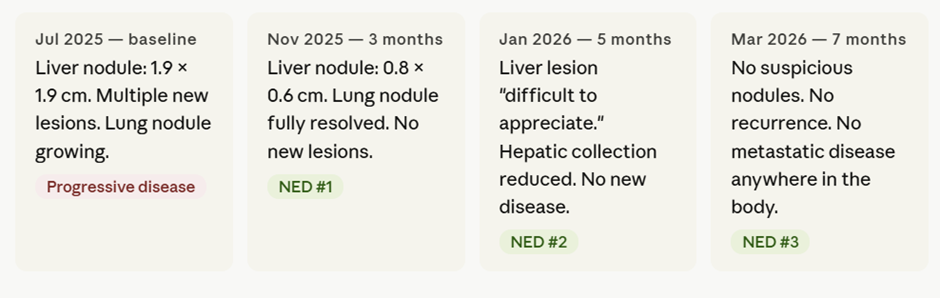
Follow-up CT scans in February 2026 brought more encouraging news. The previously suspicious thickening in the bowel area became less visible, and importantly, there were no new tumours detected. Existing nodules and lymph nodes remained stable, showing that the disease was under control rather than progressing.
Blood Tests and Internal Recovery
There were challenges along the way. Her liver function became affected, most likely due to chemotherapy, and she experienced episodes of low white blood cells and platelets.
However, with adjustments to her treatment (including adjusting ECCT regime to improve her liver, kidney and bone marrow, stopping Oxaliplatin and continuing Xeloda at a reduced dose), her condition stabilised. Liver function showed signs of improvement over time especially her liver marker, and her kidney function remained normal throughout.
Feeling the Difference: Physical and Symptom Improvement
The biggest change wasn’t just in the numbers; it was how Juliana felt.
Over time, her symptoms began to fade:
The abdominal pain and bloating resolved
Her appetite improved
Bowel movements returned to normal
Back pain and gastric discomfort disappeared
By early 2026, she was no longer the weak, fatigued patient from months before. She was sitting upright, alert, and visibly stronger.
She shared that while chemotherapy still made her feel unwell for a few days after each cycle, she would recover much faster and felt that ECCT helped her bounce back more quickly.
Getting Her Life Back
Perhaps the most meaningful part of her recovery is what it allowed her to do.
Juliana was able to travel again. She drove herself on a trip to Penang, something that would have been unimaginable just a few months earlier. She resumed her daily routines, including fasting, and regained a sense of independence.
These are not just small milestones; they represent a return to normalcy and dignity in daily life.
Where She Is Today
As of the latest follow-up:
Her disease remains stable on imaging
Tumour markers are within normal range
Liver function, while previously affected, is improving
She remains physically well, active, and independent
There are ongoing considerations, including monitoring thyroid nodules and continued follow-up scans, but overall, her condition is stable and controlled.
A Journey of Measurable Progress
Juliana’s journey reflects more than just clinical improvement. It shows how a patient who started off weak, in pain, and facing disease progression can regain strength, stability, and quality of life.
With a combination of chemotherapy and ECCT, her case demonstrates:
Reduction in tumour activity (CEA improvement)
Stabilisation of disease on imaging
Recovery of physical strength
Improved tolerance to treatment
Restoration of daily function and independence
Today, she is not just continuing treatment, she is living her life again.


Comments